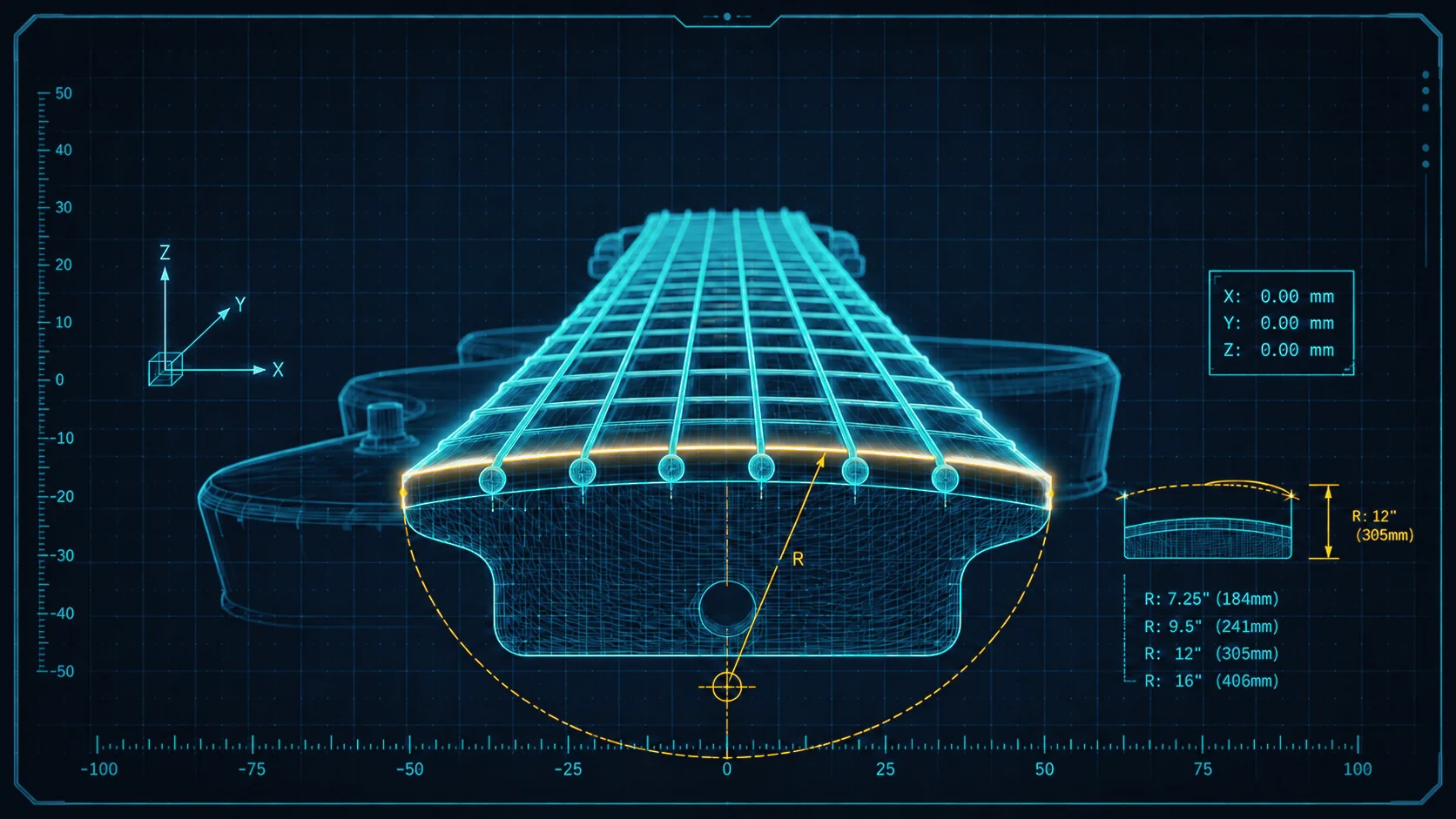
Your fretboard is curved. Your saddles should follow that curve. Enter your radius and bridge spread to get the per-string offsets.
Your Setup
Fretboard Radius Matcher
Enter your radius and bridge string spread. The offsets below tell you how much lower each outer string should sit relative to the center strings — so your action follows the curve of your board.
inches
inches
Display Unit
Fretboard arc — string positions to scale
These are relative offsets, not absolute heights. The center strings (3 & 4) are the reference point — shown as 0. Each outer string sits that much lower so your action follows the curve of the board. Use the Action Calculator to set your absolute target height first, then apply these offsets.
#Stringmm lowerthou lower
🎸 Roady Hint — How to Measure
If you are not sure of your radius, pick the preset that matches your guitar make and model — that gets you close enough for a starting point. You can always dial in a custom value if you have a radius gauge handy.
Measure the bridge string spread from the center of the Low E saddle to the center of the High E saddle. This is the number that goes in the spread field — not the nut width.
⚠ Fixed-Bridge Note
These offsets are fully actionable on individually adjustable saddles — Strat, Tele, Floyd Rose, most modern bridges. You can set each string independently.
On a fixed-radius bridge like a Tune-O-Matic (Gibson/Gibson-style), the saddle radius is set at the factory to ~12″. This tool is informational only for those guitars — it tells you what the factory already aimed for, but you cannot dial individual strings without swapping saddles.
That's your starting arc
The radius sets the shape of your saddle arc. The Action Calculator sets how high the whole arc sits. Run both and your bridge is dialled in.
Select a radius and string spread above to see your offsets.
Good to Know
Fretboard radius questions, answered
Why do my saddles need to be at different heights?
Your fretboard isn’t flat — it’s gently curved across its width, like a very shallow slice of a cylinder. For the strings to follow that same curve evenly, each saddle has to sit at a slightly different height, with the middle strings a touch higher than the outer ones. That’s exactly what this tool works out for you: enter your radius and string spread, and it gives you the height offset for each saddle so the whole set follows your board’s arc.
What if I don't know my fretboard radius?
You can usually look it up by brand and model, or measure it with a radius gauge — the Fretboard Radius Guide walks through both. As a rough reference: many modern Fender-style necks are 9.5 inches, vintage Fender is often 7.25 inches, Gibson and PRS tend to sit around 10 to 12 inches, and flatter, shred-friendly necks run 12 to 16 inches or more. A smaller number means a rounder board; a larger number means a flatter one.
What is "string spread," and how do I measure it?
String spread is simply how far apart your outer strings sit at the bridge — measured from the centre of the low E to the centre of the high E where they cross the saddles. It matters because a wider spread over the same radius means slightly bigger height differences between saddles. A quick measurement with a ruler or callipers right at the saddles is all you need for an accurate result.
Does a flatter or rounder radius play better?
It depends on what you do most. Rounder boards (smaller numbers, like 7.25 to 9.5 inches) tend to feel comfortable under the hand for chords and have a more vintage feel. Flatter boards (12 inches and up) let you set lower action and bend notes without them choking out, which lead players often prefer. Neither is “better” — it’s about your hands and your style, and plenty of players happily land somewhere in the middle.
Why do my bends choke out or fret out?
This is the classic radius-and-action puzzle. On a rounder board with the action set low, bending a string can push it up into the higher frets near the crown of the curve, and the note dies. Matching your saddles to the radius is the first fix, since it keeps the arc even; from there, a touch more height (see the Action Calculator) usually clears it. Flatter boards are naturally more forgiving here.
What's a compound radius, and which number do I enter?
A compound (or conical) radius is rounder near the nut for comfortable chording and gradually flattens toward the body for clean bends and low action — for example, 9.5 to 14 inches. Since your saddles live at the bridge end, enter the flatter radius (the larger number) here, because that’s the curve the strings follow where the saddles sit. The guide covers how to find both numbers for your neck if you’re not sure.