Theory Guide
How to Understand Major and Minor Triads on Guitar
Triads are the core of major and minor chords, and they are much easier to understand than full barre shapes. Learn the formulas, inversions, and fretboard logic behind them.
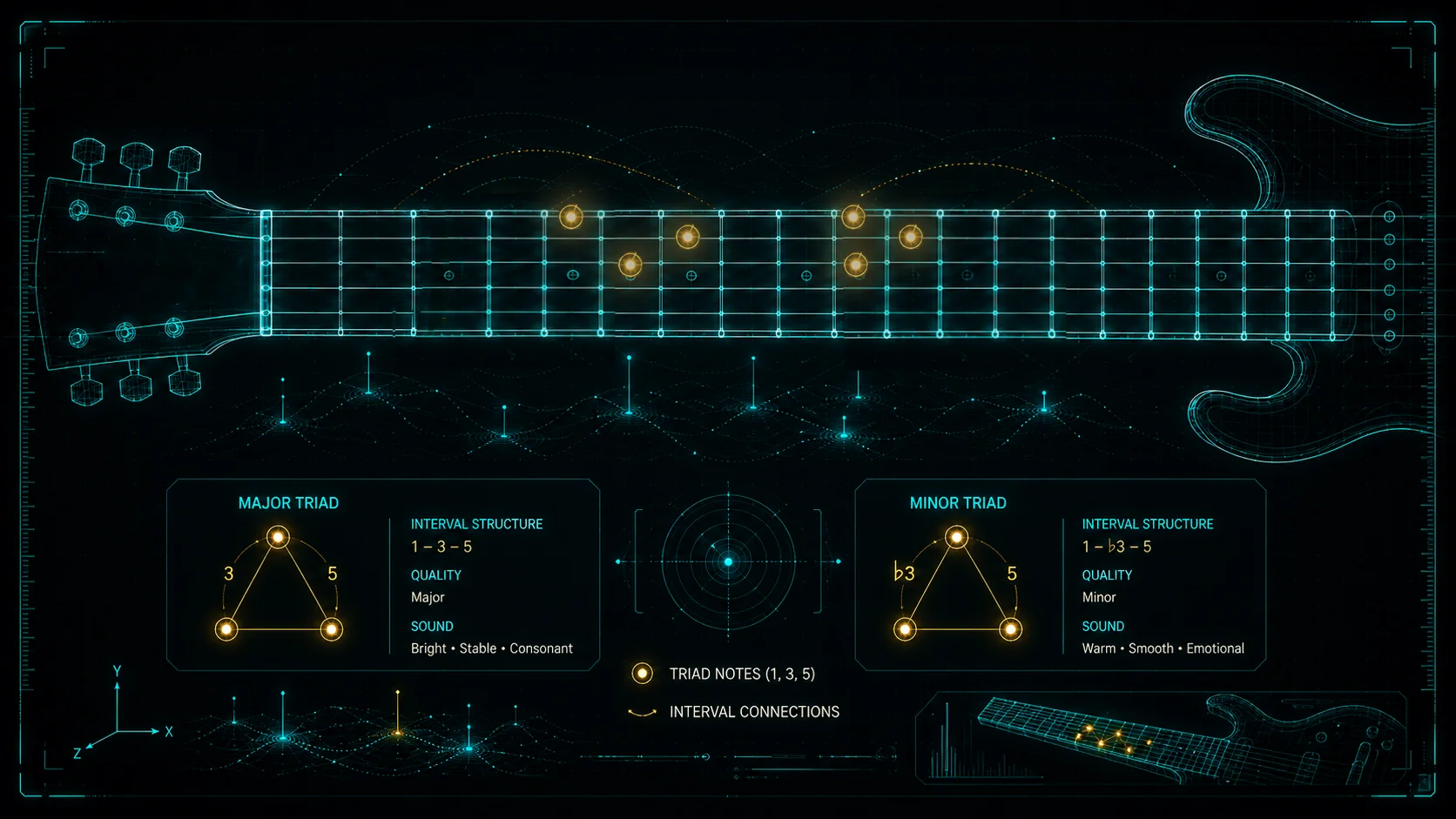
When we first pick up a guitar, most of us learn chords as big shapes that cover a lot of strings. They sound full and familiar, but they can also feel awkward to move, hard to control, and overly crowded when you are playing with other instruments. There is a simpler way to think about harmony.
That simpler way is triads. A triad is just three notes, and those three notes are the foundation of major and minor chords. Once you understand triads, the fretboard starts to feel smaller, clearer, and much easier to navigate.
What a triad is
A triad is a chord built from three unique notes. The basic formula starts with the root, then adds the 3rd and 5th. That structure is the same idea behind almost every major and minor chord you hear.
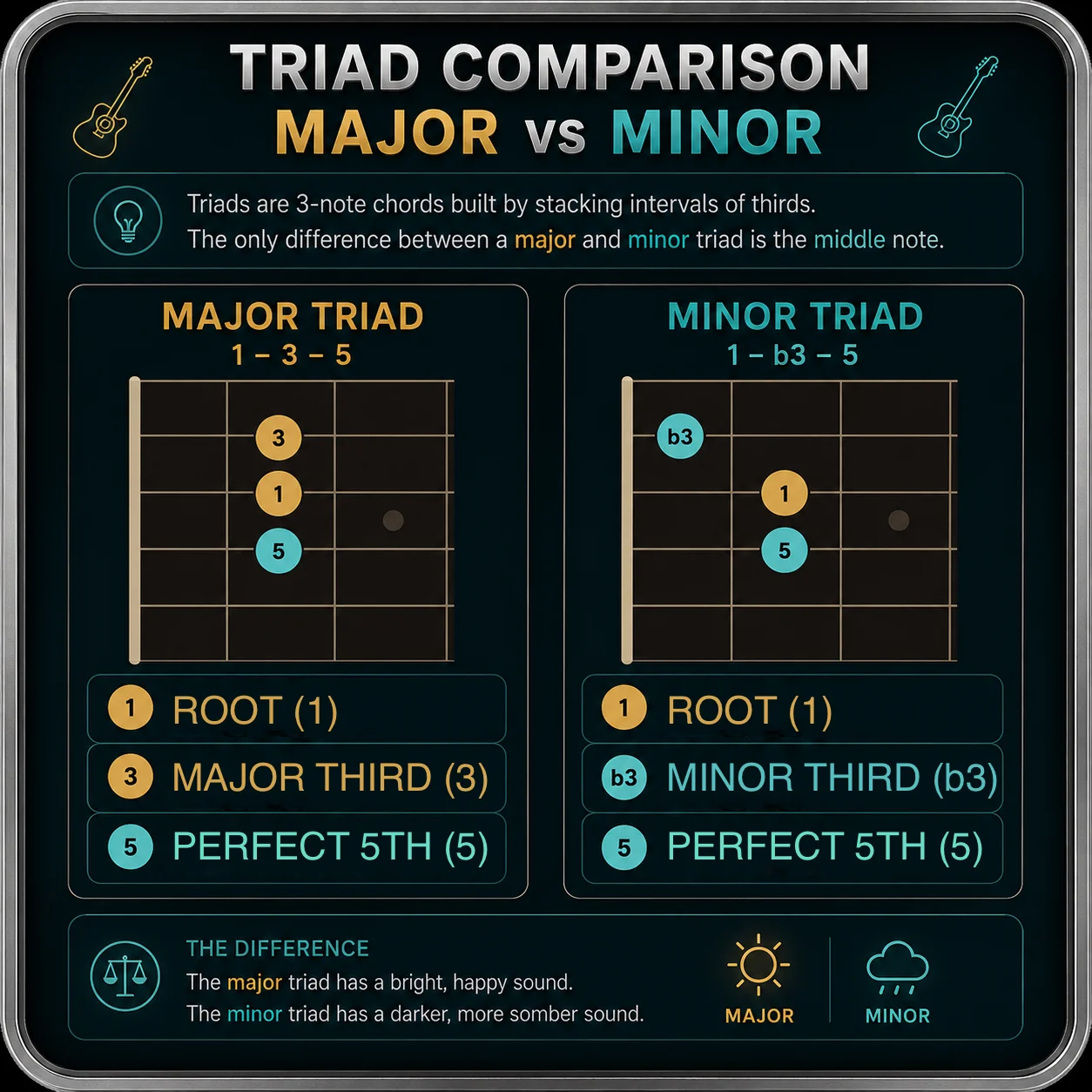
The difference between major and minor is tiny but powerful. A major triad uses 1, 3, 5. A minor triad uses 1, b3, 5. That one small change is what gives the chord its brighter or darker sound.
Brighter sound. The natural 3rd gives it an open, resolved feeling.
Darker sound. The flattened 3rd pulls the harmony inward.
The one-fret shift
The easiest way to understand the major-to-minor change is to focus on the 3rd. If you lower that note by one fret, a major triad becomes minor. That is the whole trick.
This is one of the fastest ways to understand harmony on guitar. Instead of memorizing two totally different shapes, you can think of major and minor as nearly the same structure with one small adjustment. That makes triads much easier to learn and use in real playing.
Triad inversions
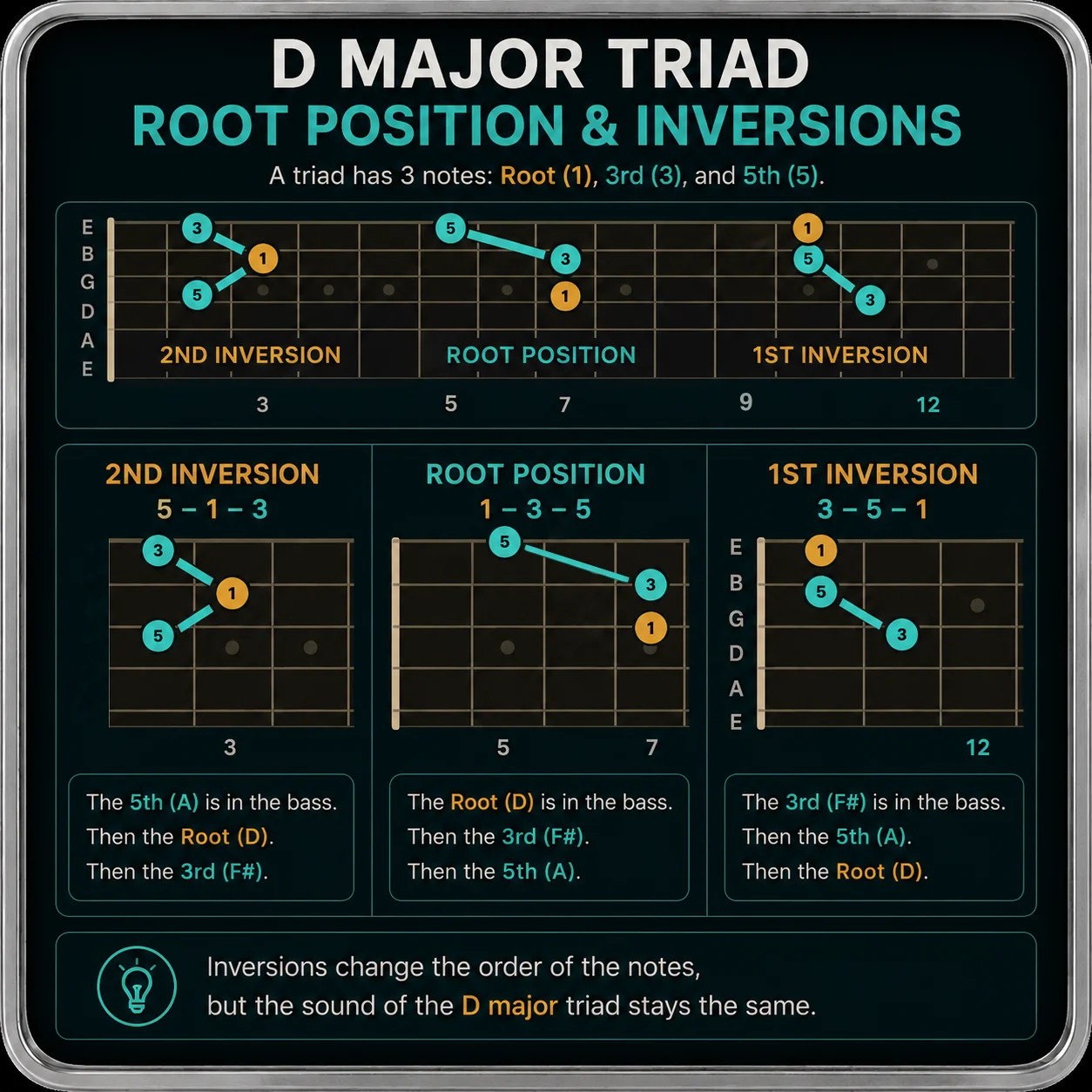
On guitar, you do not have to play the notes in the same order every time. If the root is in the bass, that is root position. If the 3rd is in the bass, that is first inversion. If the 5th is in the bass, that is second inversion.
The most stable and grounded sound. The chord sits directly on its name note.
A slightly lighter feel. Useful for smooth movement between chords.
The most open sound. Often used as a passing chord or a suspension.
These inversions matter because they let you keep the same chord quality while moving to a different area of the neck. Instead of jumping to a giant barre chord, you can stay in one zone and use a smaller, more efficient voicing. That makes rhythm playing cleaner and lead movement easier.
Why triads sound cleaner
Triads are compact, so they leave more space in the arrangement. That is helpful when you are playing with a bass player, keyboard player, or another guitarist. You still define the harmony without overcrowding the low end.
They also move more easily. A small triad shape is much simpler to slide, connect, and transpose than a full six-string chord. That makes them incredibly useful for rhythm parts, fills, and melodic chord work.
Connecting the fretboard
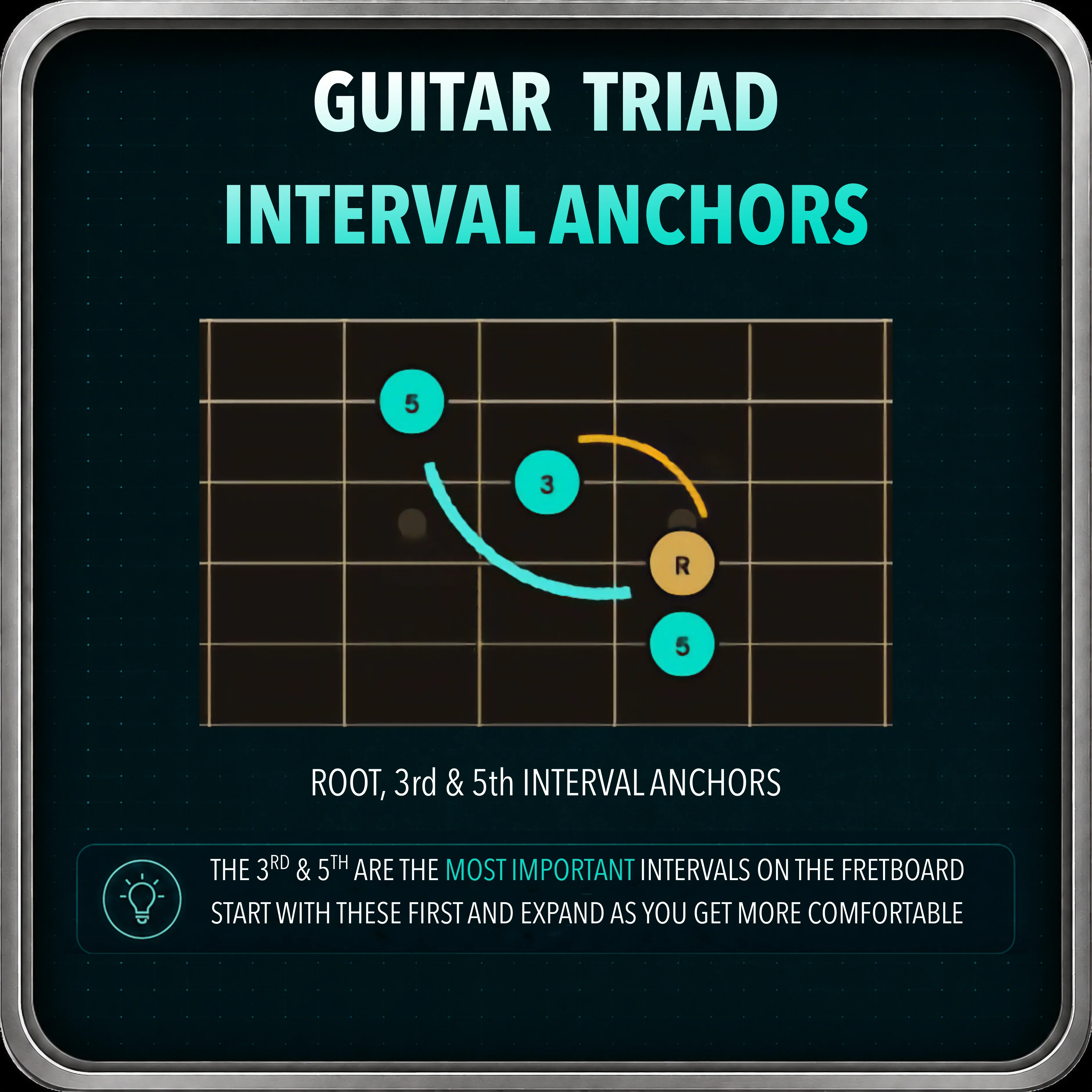
Triads also help you see the fretboard as a set of relationships instead of random chord shapes. Once you know where the root, 3rd, and 5th live, you can build harmony in more than one place. That opens the neck up in a very practical way.
This is why triads pair so well with interval thinking. If you are already learning how to decode the fretboard, triads give you a musical reason to map those intervals. The more clearly you see the relationships, the easier it gets to move around the neck confidently.
Use the CAGED Navigator
This is exactly where the CAGED Navigator helps. Instead of memorizing a dictionary of shapes, you can see major and minor triads mapped across the neck in real time. That makes the structure feel visible instead of abstract.
If you want to compare string sets, inversions, or keys, the navigator gives you a much faster learning path. It is the right tool for turning triads from theory into something you can actually play.
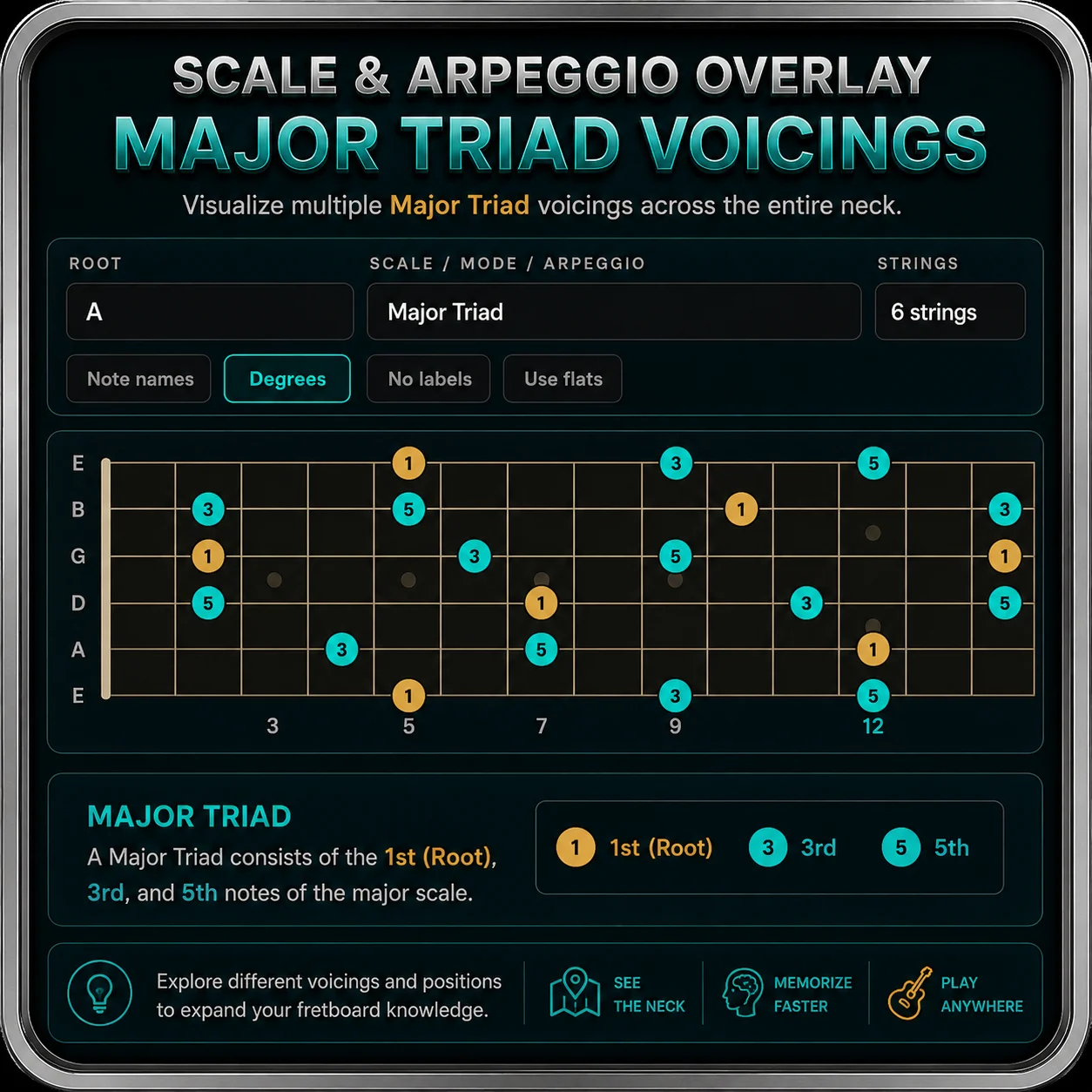
Want to see triads move across the neck? Open the CAGED Navigator to view major and minor triads, inversions, and string-set layouts in real time.
Open CAGED Navigator →The Pocket Roady order
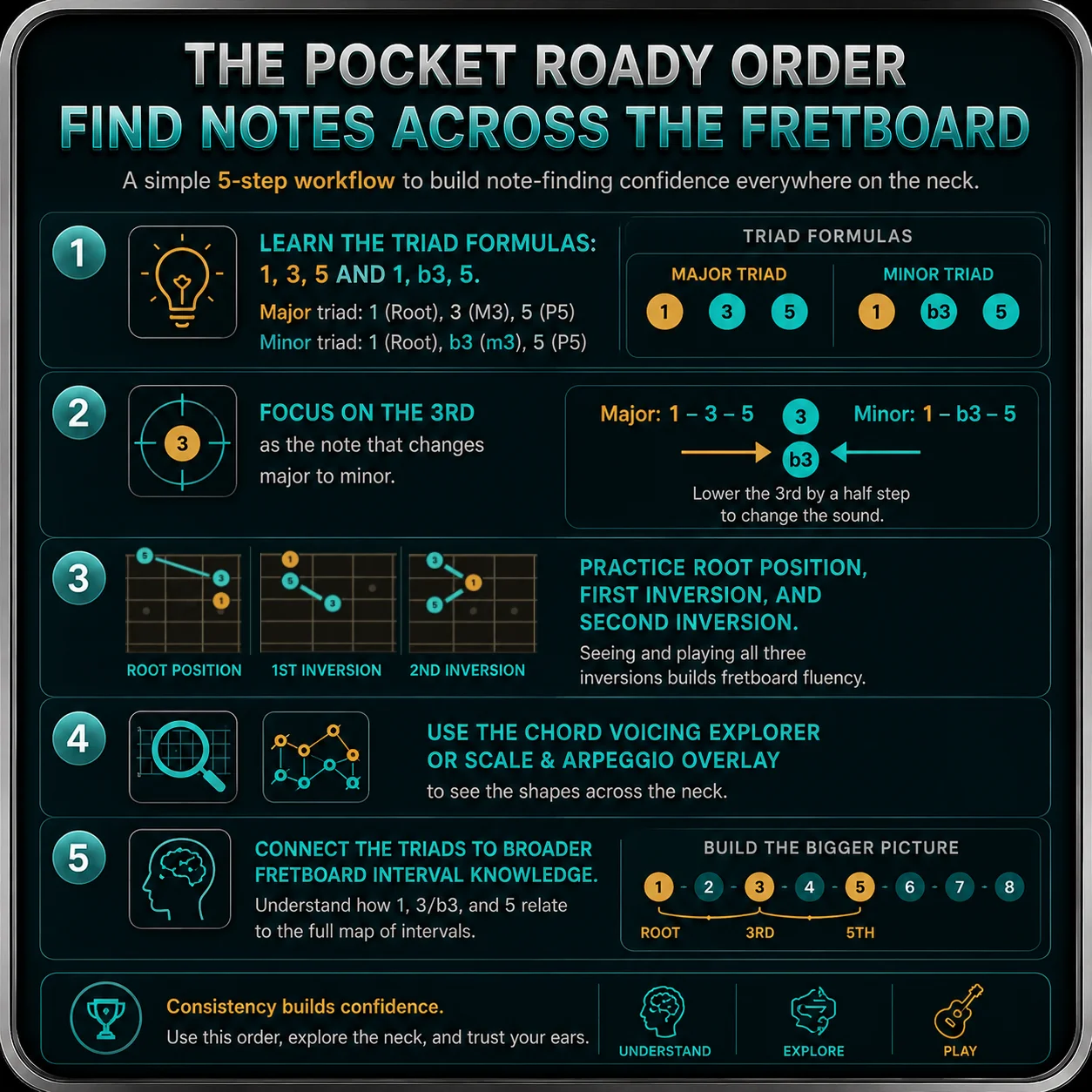
Here is the simplest workflow — start at the top and work your way down:
Learn the triad formulas: 1, 3, 5 for major and 1, b3, 5 for minor.
Focus on the 3rd as the note that changes major to minor. One fret lower — that is all it takes.
Practice root position, first inversion, and second inversion on one string set before moving to the next.
Use the CAGED Navigator or Scale & Arpeggio Overlay to see the shapes mapped across the full neck.
Connect the triads to broader fretboard interval knowledge. Once the root, 3rd, and 5th feel familiar, the whole neck opens up.
That order keeps the topic calm and practical. Once triads make sense, the whole neck starts to look less like a grid of shapes and more like a set of usable musical tools.
Where to go next
If you want to understand major and minor chords on guitar without getting lost in giant shapes, triads are the fastest place to start. They are simple, movable, and directly useful in real playing.
Want to see triads move across the neck? Open the CAGED Navigator to view major and minor triads, inversions, and string-set layouts in real time — or keep going and see how those notes connect as scales and intervals.