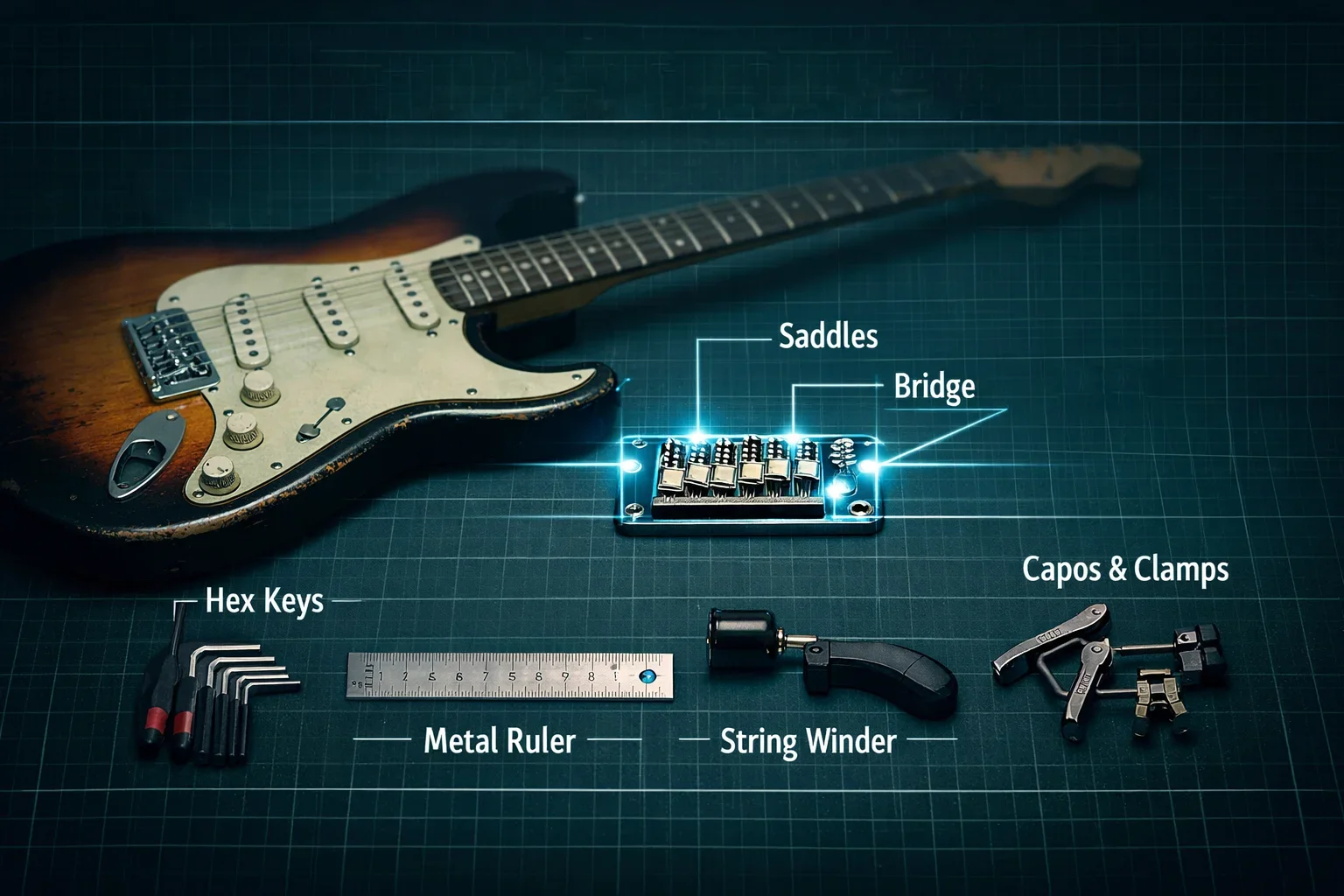
A small neck adjustment can make a big difference in feel, buzz, and playability. We'll keep this simple — no panic, no jargon, just a clear check to see what your guitar is telling you.
Takes about 2 minutes.
Good to Know
Neck relief questions, answered
What is neck relief, and why does it matter?
Neck relief is the tiny amount of forward curve in your guitar’s neck. When strings vibrate they need a little room, so a perfectly straight neck often buzzes. A small, even amount of relief gives the strings space to ring cleanly while keeping the guitar comfortable to play. Too much and the action starts to feel high; too little and you get fret buzz — so it’s worth landing in a happy middle.
How much neck relief should my guitar have?
There’s no single magic number, but a common starting point is a very small gap — roughly the thickness of a thin business card, often cited around 0.008 to 0.012 inches at the middle of the neck. Players with a light touch and low action usually want less; heavier strummers often like a touch more. Treat it as a starting point to fine-tune to your own feel, not a hard rule.
Which way do I turn the truss rod?
The truss rod pushes back against the pull of the strings. Turning it clockwise (tightening) removes relief and straightens the neck — reach for this when the gap is too big. Turning it counterclockwise (loosening) adds relief — do this when the neck is too straight or bowing backward and buzzing. View the adjustment nut from the player’s side so clockwise and counterclockwise stay clear.
How much should I turn the truss rod at a time?
Small moves. A quarter turn is plenty — make the adjustment, let the neck settle for a few minutes, then re-check before going any further. Necks respond gradually, and tiny changes add up. If the rod feels stuck, won’t turn, or nothing changes after a reasonable amount, stop and don’t force it — that’s a sign to slow down or have someone take a look. No panic, no cranking.
Why does my neck relief keep changing?
Necks are wood, and wood moves. Seasonal swings in temperature and humidity are the usual culprits — lots of players find themselves tweaking relief a little as the seasons turn. A change in string gauge or tuning shifts how hard the strings pull, too, which is another common reason the neck drifts. An occasional re-check is completely normal, not a sign anything’s wrong.
Do I need to adjust the truss rod after changing string gauge?
Often, yes. Heavier strings pull harder on the neck and can add relief, while lighter strings do the opposite — so a real gauge change is a good moment to re-check. If you’re switching sets, the string tension calculator shows how much the pull changes, and a quick relief check afterward keeps everything feeling right.